Sticky Notes: The Classical Music Podcast
- Autor: Vários
- Narrador: Vários
- Editora: Podcast
- Duração: 250:41:18
- Mais informações
Informações:


Sinopse
Sticky Notes is a classical music podcast for everyone. Whether you are a beginner just looking to get into classical music but don't know where to start, or a seasoned musician interested in the lives and ideas of your fellow artists, this podcast is for you. The show will feature interviews with the top artists of today, in-depth looks at specific pieces from the repertoire, and deep dives into each era of classical music, plus much more.
Episódios
-
![Lili Boulanger: Psalm 130]()
Lili Boulanger: Psalm 130
16/04/2026 Duração: 46minThe story of Lili Boulanger's life is one of the most fascinating and tragic in all of musical history. A remarkably precocious talent, Boulanger learned to read sheet music before the alphabet, played the violin, piano, cello, and harp, and composed regularly from a young age. Despite her talent and commitment, Boulanger suffered from chronic illness her entire life, which severely dampened her budding career and prevented her from reaching her potential. She died at the age of just 24, likely from Crohn's disease, and left behind several spectacular pieces that unfortunately were soon relatively forgotten. Boulanger's sister, Nadia, became one of the preeminent composition teachers of the 20th century, working with luminaries such as Aaron Copland, Elliott Carter, David Diamond, Philip Glass, Astor Piazzolla, and many more. But throughout the 20th century there was very little interest in Lili Boulanger's musical output. That has changed somewhat with a renewed focus on bringing the works of female composer
-
![Tchaikovsky Symphony No. 6 (Part 2)]()
Tchaikovsky Symphony No. 6 (Part 2)
02/04/2026 Duração: 48minIn a letter to Tchaikovsky's nephew Vladimir Davydov, Tchaikovsky wrote: "I'm very pleased with its content, but dissatisfied, or rather not completely satisfied, with the instrumentation. For some reason it's not coming out as I intended. It would be typical and unsurprising if this symphony were torn to pieces or little appreciated, as that wouldn't be the first time such a thing had happened. But I absolutely consider it to be the best, and in particular the most sincere, of all my creations. I love it as I have never loved any of my other musical offspring." I'm returning to that word sincere this week for Part 2, because it's the through line that makes Tchaikovsky's music so immediately arresting. You always know exactly where you stand with Tchaikovsky, since he always seems to be speaking so honestly in his music. Well, almost always. The last two movements of Tchaikovsky's 6th Symphony are among the most fascinating in the entire Western classical repertoire, and the reason for their fascination (
-
![Tchaikovsky Symphony No. 6 (Part 1)]()
Tchaikovsky Symphony No. 6 (Part 1)
21/03/2026 Duração: 50minThe great and somewhat controversial conductor Leopold Stokowski said this about Tchaikovsky: "His musical utterance comes directly from the heart and is a spontaneous expression of his innermost feeling. It is as sincere as if it were written with his blood." I couldn't agree more with Stokowski, because I think he hits on a word that has made Tchaikovsky's music so powerful to almost every audience that encounters it: sincere. Tchaikovsky's music is so profoundly moving because you feel as if there is no gap between the music and Tchaikovsky's emotions. It's as if he is earnestly speaking to you through his music. But paradoxically, this ability that Tchaikovsky had made him a punching bag of critics and cynics throughout his career and even into today. Even though Tchaikovsky remains one of the most popular composers in the Western Classical canon, his name is still not treated with the respect of a composer like Beethoven or Brahms or other luminaries. I understand that, but I also think Tchaikovsky's sk
-
![Beethoven String Quartet, Op. 59, No.2]()
Beethoven String Quartet, Op. 59, No.2
05/03/2026 Duração: 56minI'm always tickled by composer trivia questions, like which standard canon works begin in a major key and end in a minor key? I'll give you one, but please comment others below: Mendelssohn's 4th Symphony. Well, how about this one: how many of Beethoven's 16 string quartets end in a minor key? The answer? Just one, Op. 59, No. 2, the subject of today's show. And that minor key is hugely important to this darkest of the three Op. 59 quartets, three towering achievements that changed the string quartet repertoire for good. Beethoven, as I've said many times on the show, was a revolutionary within limits, always expanding, rethinking, and reshaping what was possible without breaking anything beyond repair. But make no mistake: the Op. 59 quartets were revolutionary works. No one had written anything like them before in terms of scope, emotional intensity, difficulty, and complexity. In fact, like a few of Beethoven's greatest works, they were received with confusion and, in some cases, anger by musicians, audi
-
![Brahms Symphony No. 2 LIVE w/ The Aalborg Symphony]()
Brahms Symphony No. 2 LIVE w/ The Aalborg Symphony
19/02/2026 Duração: 58minBrahms spent much of his adult life battling with his ambition to write the next great symphony and his terror at the shadow of Beethoven standing behind him. Brahms tortured himself for 14 years with his first symphony, and only published it when he was 49 years old. But when that symphony finally came out, it was a relative success for a new work, and with immense relief, Brahms quickly turned out another symphony in just 4 months. Brahms' first symphony was quickly dubbed "Beethoven's 10th" something that annoyed Brahms to no end. When told that the main theme of the last movement resembled the Ode to Joy, he notoriously responded, "any ass can see that!" But all the same, Brahms had been re-anointed as Beethoven's successor with the symphony, and so therefore his second symphony would also be given a Beethovinian name, Pastoral. The question since the symphony has been written has been this: just how pastoral and idyllic is this symphony? Many commentators see an unadulterated joy and gentleness in
-
![Zemlinsky: The Mermaid]()
Zemlinsky: The Mermaid
05/02/2026 Duração: 01h01minThe story of Alexander von Zemlinsky's The Mermaid begins with a passionate love affair and ends in heartbreak of the most unabashedly big-R Romantic kind. In 1900, the young, fabulously talented, and famously beautiful Alma Schindler came to Zemlinsky's home to study composition. Wildly passionate feelings soon developed between them, and Alma wrote the following in her diary: "I would gladly be pregnant for him, gladly bear his children. His blood and mine, commingled: my beauty with his intellect. I would gladly serve him in his professional life, live for him and his kith and kin, breathe [for him], attend to his every happiness, serve him with a gentle hand. God give me the strength and the willpower to do so." The relationship lasted a little over a year, until one night when Schindler attended a party that happened to be frequented by a brilliant conductor and composer twenty years her senior: Gustav Mahler. The rest is history. Zemlinsky was devastated and poured his energies into a tone poem based on
-
![Pergolesi Stabat Mater]()
Pergolesi Stabat Mater
22/01/2026 Duração: 59minMany aspects of Giovanni Battista Pergolesi's life seem relatively normal when it comes to composers of the Baroque era. He was prolific, died young, and his music became very famous only after his death. However, all three of these facts are complicated by the unique circumstances of Pergolesi's life. He was somewhat prolific, but dozens of pieces that were once attributed to him are no longer considered authentic, including much of the music that Igor Stravinsky made famous in his ballet Pulcinella. Pergolesi did not just die young; he died remarkably young, at the age of twenty-six, from tuberculosis. And the idea that he became famous only after his death actually made him unusual among composers of his time, when popularity during one's lifetime was the primary mark of success. Most composers quickly fell into obscurity after they died. In Pergolesi's case, the opposite occurred. There was a massive surge of interest in his music immediately after his death, which in some ways contributed to the museum-l
-
![Rachmaninoff Piano Concerto No. 2]()
Rachmaninoff Piano Concerto No. 2
08/01/2026 Duração: 52minWe humans seem to love comeback stories, and there is no comeback quite as compelling in the classical music world as Rachmaninoff's Second Piano Concerto. It was written three years after the disastrous premiere of his First Symphony, a premiere so catastrophic that it lives on in the annals of musical history, and is the essential starting point for understanding the Second Piano Concerto and how it came to be. The concerto revived both Rachmaninoff's career and his spirits, and it remains his most famous orchestral work. It is a towering masterpiece of Romanticism, overflowing with glorious melody after glorious melody, supported by virtuosic and sumptuous writing for the solo piano, and a deeply satisfying orchestral part that continues to make audiences swoon around the world. Today on the show, we'll begin with the story of Rachmaninoff's First Symphony, and then walk through this extraordinary concerto, highlighting what truly makes Rachmaninoff's music so special. Hint: it's not just the pretty melodi
-
![Handel Messiah w/ Aram Demirjian]()
Handel Messiah w/ Aram Demirjian
18/12/2025 Duração: 01h09minA piece that I have been asked to cover probably a dozen times is Handel's Messiah. It's a piece I love, but a piece that I've never conducted or played, and so therefore I don't know it incredibly well. There are plenty of pieces like this in the repertoire, and so I've decided to start a new series on Sticky Notes, which will be to take pieces that I don't know very well and to bring on experts to help me learn about them. This series will be a bit sporadic, and won't disrupt the but I'm really excited to share the first episode in this series, all about the Handel Messiah, featuring my good friend and the wonderful conductor Aram Demirjian, the Music Director of the Knoxville Symphony! I really hope you enjoy this episode and that you have a Happy Holidays and New Year!
-
![Gustav Holst: The Planets]()
Gustav Holst: The Planets
04/12/2025 Duração: 01h02minMr. Holst, wherever you are, I apologize in advance for what I'm about to say. From my research, I know you resented this fact, but unfortunately, I think it's true. Here it is: despite the large catalogue of music Gustav Holst composed, much of it wonderful, he is essentially a one-hit wonder in the classical music world, à la Pachelbel, Dukas, Mascagni, and others. His one hit is a big one, though: an epic, seven-movement suite entitled The Planets. As I said, Holst was not happy about this in the slightest. He was a prolific composer and someone who devoted himself fully to his subjects. He considered other works he wrote better than The Planets, and yet, in the end, we hear very little of his other music, though since the 1980s some of it has been performed more frequently, particularly in the UK. But The Planets is truly a hit: the reason we know Holst's name today, and one of the most frequently performed pieces in the entire Western classical canon. Holst took a novel approach to his depiction of the p
-
![Franck Symphony in D Minor]()
Franck Symphony in D Minor
20/11/2025 Duração: 59minIn the 1960s, Leonard Bernstein famously helped to popularize the music of a then relatively obscure composer, Gustav Mahler. His work, as well as the work of other conductors, made Mahler into a classical-music household name. Mahler's symphonies are played every year all over the world, and he is firmly ensconced in the so-called canon of standard orchestral repertoire. Would it surprise you to know that Franck's D Minor Symphony once had the same reputation? It was played almost every year by most major orchestras, it was recorded by all the great conductors, and it was a fixture of the canon just like a Brahms symphony. Nowadays you would be lucky if, outside of France and Belgium, you hear Franck's Symphony once every five years, if that. The truth is that, other than a short golden period for this symphony, it has either been controversial (around the time it was premiered) or ignored (nowadays), which is a real shame, since it is a glorious piece that I would argue is drastically underrated in our mode
-
![Ravel and Falla: Echoes of Spain]()
Ravel and Falla: Echoes of Spain
06/11/2025 Duração: 57minNowadays it's hard to imagine Maurice Ravel as a "bad-boy" revolutionary, a member of a group whose name can be loosely translated as The Hooligans. To most listeners today, Ravel's music is the very picture of sumptuous beauty. But the group he belonged to, Les Apaches ("The Hooligans"), earned its name because of its members' uncompromising attitudes about music; attitudes that clashed sharply with the conservative tastes of the establishment. Another composer who belonged to Les Apaches was the Spanish composer Manuel de Falla. Falla is certainly not as well known as Ravel, but the two became fast friends when he arrived in Paris in 1907. They formed a kind of mutual-admiration society that proved immensely fruitful for both of them. Falla was deeply impressed by Ravel's Spanish-inflected music, marveling at its authenticity given that Ravel was French. But Ravel, now a symbol of French music, was the son of a Swiss father and a Spanish-speaking mother, and he was born just eleven miles from the Spanish bo
-
![Shostakovich Symphony No. 10 LIVE w/ The Aalborg Symphony]()
Shostakovich Symphony No. 10 LIVE w/ The Aalborg Symphony
27/10/2025 Duração: 59minLongtime listeners of Sticky Notes know that Shostakovich's 10 symphony was the inaugural piece covered on the show. It's been 8 years(!) since that show, so I've totally re-written the episode and had the privilege of presenting this new version live with the Aalborg Symphony Orchestra last week in Aalborg. Shostakovich, like so many composers before him, was obsessed with musical codes and messages, with songs that expressed two or more meanings, with ideas that were at once black and white and profoundly complex. This also describes Shostakovich himself, a man who was incredibly guarded with his public persona, and even his private persona as well. It is impossible to know anything for sure with Shostakovich, and to me therein lies the greatest strength of his music. The 10th symphony has been described as a portrayal of the Stalin years, as a portrayal of obsessive love, as a requiem, as sarcastic, as humorous, as agonizing, as triumphant, as, as, as….and the truth is that like all of the greatest works o
-
![Barber Violin Concerto]()
Barber Violin Concerto
09/10/2025 Duração: 47minThere are so many great apocryphal stories in the long history of classical music, from the reason Tchaikovsky wrote his Sixth Symphony to what famous composers supposedly said on their deathbeds, to my favorite story: how Joseph Haydn’s Symphony No. 96, The Miracle, got its name. Apparently, during the premiere of the symphony, a chandelier fell, but miraculously didn’t hit anyone. Hence, The Miracle Symphony. The chandelier did, in fact, fall, but we now know it happened during the premiere of Haydn’s Symphony No. 102, which has no nickname. Coincidentally, or perhaps not so coincidentally, the 96th Symphony is performed far more often than the 102nd, likely because of its nickname, even though it’s the nickname of the wrong symphony. The Barber Violin Concerto has a great and true story behind it. But before certain information was revealed in 2010, the story everyone knew was quite different. The original version goes like this: Barber had completed the first two movements of his Violin Concerto and sent
-
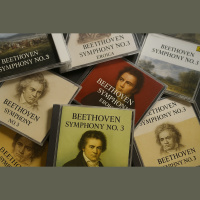
![100 Years of Beethovens Eroica (recordings)]()
100 Years of Beethoven's Eroica (recordings)
25/09/2025 Duração: 55minOne of my favorite things about having Patreon sponsors is that they often suggest the most fascinating pieces and topics for shows. Adrian, who sponsored a show last year, gave me one of my favorite prompts when he suggested looking at works based on literature. Now he’s sponsored another episode, this time with an equally compelling idea that I was eager to explore right away. His prompt was: “The evolution of conducting techniques throughout recorded history. How have innovations from great conductors changed how music is performed and understood?” As a conductor, the thought of diving into different recordings of a single piece naturally whets my appetite. But the real reason I was so excited about this episode is that interpretation is, in my view, wildly misunderstood. I’ve tried to tackle this idea in many different ways, in my episode about the sound of the violin with Soovin Kim and my dad, Donald Weilerstein; in my “What Does Music Mean?” episode; and even in “What Does a Conductor Really Do?” But I
-
![The Life and Music of Grazyna Bacewicz]()
The Life and Music of Grazyna Bacewicz
06/09/2025 Duração: 57minThe great Polish composer Witold Lutoslawski said this after the premature death of his contemporary Grazyna Bacewicz: “She was born with an incredible wealth of musical talent, which she succeeded to bring to full flourish through an almost fanatical zeal and unwavering faith in her mission. The intensity of her activities was so great that she managed, in a cruelly-shortened life, to give birth to such treasures that any composer of her stature with a considerably longer life span could only envy.” Bacewicz is a name that is probably not that familiar to you, but during her lifetime she was an extremely popular composer in her native Poland and across Europe as well. In the United States, her music has been rarely performed, though this has started to shift thanks to a renewed interest in female composers of the past. This new look at Bacewicz has revealed an incredible wealth of music. Bacewicz was one of the most prolific composers of the 20th century, writing over 200 works during her short lifetime! Som
-
![Sticky Notes meets Youll Hear It]()
Sticky Notes meets You'll Hear It
22/08/2025 Duração: 01h10minI had such a wonderful time joining the jazz podcast You'll Hear It! We talked about the meeting of jazz and classical music, a topic I've explored before, but never in this much depth and never with so much input from jazz musicians and experts like Peter Martin and Adam Maness. We talk about great jazz and classical composers, but we also talk about the strange divide between jazz musicians and classical musicians, trying to break down the barriers that exist between purveyors of these wonderful genres of music. I hope you enjoyed this one as much as I did!
-
![Impressions in Blue: Ravel Gershwin]()
Impressions in Blue: Ravel & Gershwin
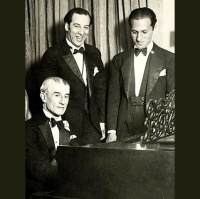
07/08/2025 Duração: 44minIn the mid-1920s, Maurice Ravel wrote a letter to the legendary composition teacher Nadia Boulanger. Boulanger’s class was a mecca for composers, both young and old, and musicians from all over the world vied to study with her. But Ravel’s letter wasn’t on his own behalf. Instead, he urged Boulanger to take on a young student whom Ravel himself had declined to teach. He wrote: "There is a musician here endowed with the most brilliant, most enchanting, and perhaps the most profound talent: George Gershwin. His worldwide success no longer satisfies him, for he is aiming higher. He knows that he lacks the technical means to achieve his goal. In teaching him those means, one might ruin his talent. Would you have the courage, which I wouldn’t dare have, to undertake this awesome responsibility?" Boulanger also declined to take Gershwin as a student, fearing, like Ravel, that she might damage his spontaneity and dynamic jazz sensibility. Whether or not the famous story is true (that Ravel turned down Gershwin’s req
-
![Beethoven Piano Sonata in B Flat Major, Op. 106, Hammerklavier - Part 2]()
Beethoven Piano Sonata in B Flat Major, Op. 106, "Hammerklavier" - Part 2
24/07/2025 Duração: 53minThere is a special category when it comes to Beethoven; a catalogue that doesn’t include complete symphonies, sonatas, concerti, string quartets, etc., but just single movements. This is the catalogue of great Beethoven slow movements. Beethoven’s slow movements are like a great Tolstoy novel. They span the gamut of human experience and also reach beyond it, into something we cannot understand but all somehow perceive. Simply put, Beethoven often seems to know us better than we know ourselves. This brings me to the slow movement of Beethoven’s Hammerklavier Sonata. Unlike those late quartet slow movements, the slow movement of the Hammerklavier is not about ecstatic contemplation. Instead, it is a movement of pure and profound despair. It has been described as “a mausoleum of the collective suffering of the world,” and “the apotheosis of pain, of that deep sorrow for which there is no remedy, and which finds expression not in passionate outpourings, but in the immeasurable stillness of utter woe.” This is not
-
![Beethoven Piano Sonata in B♭ major, Op. 106, Hammerklavier - Part 1]()
Beethoven Piano Sonata in B♭ major, Op. 106, "Hammerklavier" - Part 1
10/07/2025 Duração: 44minBeethoven once wrote to his publisher: “What is difficult, is also beautiful, good, great, and so forth. Hence everyone will realize that this is the most lavish praise that can be bestowed, since what is difficult makes one sweat.” If this credo manifests itself most powerfully in any one of Beethoven’s works, it might be the piece we’ll talk about today, the piano Sonata Op. 106, nicknamed, “Hammerklavier.” It is the longest Sonata Beethoven ever wrote, which essentially means that it was the longest sonata anyone had written up to that point. It marks one of the pivot points between Beethoven’s so-called heroic period and his late period, where his music became even more cosmically beautiful than before. It is certainly his most ambitious Sonata to that point, and his most difficult. The scale of the Hammerklavier sonata is hard to describe; in around 45 minutes of music, Beethoven explores the full gamut of human emotion. The intensity, the difficulty, and the concentration that this sonata requires from