The Zen Studies Podcast
- Autor: Vários
- Narrador: Vários
- Editora: Podcast
- Duração: 170:14:34
- Mais informações
Informações:


Sinopse
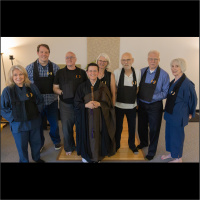
Host Domyo Burk is a Soto Zen priest and teacher. She records episodes specifically for podcast listeners on traditional Zen and Buddhist teachings, practices, and history.
Episódios
-
![310 - Three Paths: The Value of Monastics, Clergy, and Lay Practitioners in Western Zen]()
310 - Three Paths: The Value of Monastics, Clergy, and Lay Practitioners in Western Zen
16/08/2025 Duração: 38minSince the Buddha’s time, certain practitioners have chosen to leave the household life to dedicate themselves completely to formal Buddhist training. Undergoing a ceremony of ordination in which they took monastic vows, these monks and nuns lived the remainder of their lives within a Sangha – community – of other ordained people. In modern Western Zen, you will find a thoroughly confusing situation where ordained people who live fully monastic lives are rare, most ordained people are called “priests” and live householder lives, and practitioners who are not ordained often teach the Dharma and lead lay Sanghas (functions historically reserved for ordained people). What is the use – if any – of continuing with a tradition of “ordination?” I discuss the value of monks, priests, and lay practitioners in the context of Zen as it is currently manifesting in the United States.
-
![309 - Dana, the Paramita of Generosity: Buddhist Teachings on Giving (2 of 4)]()
309 - Dana, the Paramita of Generosity: Buddhist Teachings on Giving (2 of 4)
31/07/2025 Duração: 32minI discuss the oldest source of Buddhist teachings on Dana as a bodhisattva perfection – the Jataka tales, or stories about Shakyamuni Buddha’s remarkable actions during previous lifetimes. Such stories inspired people to follow the bodhisattva path in both Theravadin and Mahayana Buddhism, so I spend some discussing the Theravadin paramis, and particularly the parami of Dana.
-
![308 – QA: Sharing the Dharma with Children, Mindfulness, and a Posture Mistake]()
308 – Q&A: Sharing the Dharma with Children, Mindfulness, and a Posture Mistake
16/07/2025 Duração: 35minIn this episode I answer listener questions: How do you address the dharma and practice with young kids? If I'm trying to be mindful on work breaks, should I just go cold turkey and not look at my phone at all or maybe try a more moderate approach like eating my meal and then looking at my phone? Is it even possible to be mindful while looking at social media, checking email, etc.? And: When sitting in meditation posture, what should I do with my stomach?
-
![307 - Dana, the Paramita of Generosity: Buddhist Teachings on Giving (1 of 3)]()
307 - Dana, the Paramita of Generosity: Buddhist Teachings on Giving (1 of 3)
08/07/2025 Duração: 41minDana, generosity or giving, is the first Mahayana Buddhist paramita. Generosity is where the journey to self-transcendence begins. In this first episode on Dana, I give an overview of the Buddha’s teachings on the virtue of giving. These teachings are from before Dana was defined as one of the paramis or paramitas – that is, perfections cultivated by someone on the bodhisattva path. In the next episode I discuss Dana as a perfection.
-
![306 – Teisho: Ordinary Mind Is the Way, Never Apart from This Very Place]()
306 – Teisho: Ordinary Mind Is the Way, Never Apart from This Very Place
01/07/2025 Duração: 26minThis is a teisho - kind of like a cross between a Dharma Talk and guided meditation. I hope my words will point you toward how the Great Matter - that which we seek to awaken to and manifest - is never apart from this very place. Ordinary mind is the Way, and is buddha itself. But what does this really mean? Not that we can't hope for relief from the turmoil of our minds as we usually experience them! Mind-with-a-capital-M is not equivalent to our thoughts, feelings, emotions, and concepts. Mind is the undisturbed space within which everything arises, so it is always available to us - never apart from this very place.
-
![305 - Dharma Foundations: Truths to Rely on No Matter What]()
305 - Dharma Foundations: Truths to Rely on No Matter What
19/06/2025 Duração: 35minReligions and spiritual paths are meant to give you strength and help you find meaning. Many people derive strength and meaning through faith in an all-powerful God who works in mysterious ways but ultimately has your best interests in mind. Buddhism doesn’t teach this kind of faith, but it does call attention to many truths upon which we can rely for strength and meaning, no matter what happens to us personally or in the world. For the purpose of this discussion, I’m going call the truths we can rely on “Dharma Foundations.”
-
![304 - Supporting the Zen Practice of People with Physical Challenges (2 of 2)]()
304 - Supporting the Zen Practice of People with Physical Challenges (2 of 2)
01/06/2025 Duração: 42minIn this episode I make the case for accommodations for people with physical challenges, even in sesshin, and then describe a number of tried and tested ways Sanghas can do this. I finish by talking about how to negotiate with a Sangha if you are someone with physical challenges and hope to be accommodated, particularly in the practice of intensive retreat.
-
![303 - Supporting the Zen Practice of People with Physical Challenges (1 of 2)]()
303 - Supporting the Zen Practice of People with Physical Challenges (1 of 2)
25/05/2025 Duração: 27minPeople with extra physical challenges - disabilities, chronic illnesses, or advanced age - often find it impossible to participate fully in Zen practice without special accommodations. Seated meditation (zazen) can be painful, and the demands of silent meditation retreats (sesshin) can be prohibitive. However, an important part of Zen practice - especially sesshin - is how everyone follows the forms together, doing the same things at the same times. The whole idea is to minimize the need to exercise personal choice, and to use a certain amount of physical discomfort to bring us up against the existential matter of our lives. How can Sanghas support the Zen practice of people with physical challenges while preserving what is supportive to those without them?
-
![302 – QA: Standing Up for What’s Right, and Zazen Versus Dissociation and Trance]()
302 – Q&A: Standing Up for What’s Right, and Zazen Versus Dissociation and Trance
16/05/2025 Duração: 35minIn this extemporaneous Q&A episode, I address these questions: What is the responsibility of Buddhists to stand for what is right? What is the difference between the Buddhist goal of "detaching from clinging and aversion" and the pathological states of detachment from reality called "dissociation?" How would you describe the desirable level of overlap between shikantaza (the zazen of just sitting) and trance?
-
![301 – Teisho: You Have to See Your Nature]()
301 – Teisho: You Have to See Your Nature
01/05/2025 Duração: 28minThis episode is a Teisho, an encouragement talk that’s meant to be listened to while you are sitting quietly. Zen teachers give Teisho during sesshin, and this amounts to a more formal kind of Dharma talk, almost like a meditation. It’s not meant to be educational. I’m curious as to how it will come off if you listen to it while walking or driving or doing something else. Maybe it’ll be cool. But I recommend sitting still if you’re able. Teisho are generally only given during sesshin and not recorded, but I recreated one from the sesshin I led last week for you.
-
![300 - One Reality, Many Descriptions Part 6: Trikaya, the Three Bodies of Buddha]()
300 - One Reality, Many Descriptions Part 6: Trikaya, the Three Bodies of Buddha
21/04/2025 Duração: 34minThe teaching of the Trikaya, or Three Bodies of Buddha, is challenging. It may seem to be metaphysical speculation or surprisingly theistic for Buddhism. However, it offers a unique and valuable framing for the mystery of awakening, the palpable presence of the Ineffable despite its ungraspable nature, and the relationship of all phenomena to the Ineffable.
-
![299 – QA: Revisiting Veganism and Moral Choices, and Questions about Shikantaza]()
299 – Q&A: Revisiting Veganism and Moral Choices, and Questions about Shikantaza
11/04/2025 Duração: 32minIn this extemporaneous question-and-answer episode I address a listener's comment on my answer in a recent Q&A episode about the relationship between Buddhism and eating a plant-based diet. Then I respond to two different questions about the practice of shikantaza, or just sitting.
-
![298 – Framing Your Dharma Practice in a Helpful Way]()
298 – Framing Your Dharma Practice in a Helpful Way
31/03/2025 Duração: 22minChances are, whether you're aware of it or not, you have a certain way of framing your Dharma practice. That is, you function using a conceptual framework that defines your relationship to your practice, the intent of that practice, and what is supposedly being transformed by that practice. When you're centered in the moment, you can practice without framing, but most of the time you'll be framing things whether you mean to or not. It's good to be conscious of your framing and choose a framing that's helpful.
-
![297 – Investigating the Wandering Mind]()
297 – Investigating the Wandering Mind
15/03/2025 Duração: 36minAlmost everyone who practices meditation or mindfulness encounters the phenomenon of the wandering mind – when, despite your conscious intention, your mind is filled with thoughts that have nothing to do with your current experience. You can employ various techniques to let go of the thoughts and “bring the mind back” to your meditative object or to the present moment, but often these techniques are applied as if all mind wandering was of the same nature. I investigate different reasons your mind wanders and how they call for different responses.
-
![296 – QA: Paramis, Mindfulness, Karma, and Enjoyment]()
296 – Q&A: Paramis, Mindfulness, Karma, and Enjoyment
07/03/2025 Duração: 34minThis is an extemporaneous question-and-answer episode. Do you know the difference between a parami and a paramita? Do I still like to think of mindfulness as "undivided presence?" What about when Buddhists use the idea of karma as an excuse not to take compassionate action? Why can't our practice include more activities aimed at the cultivation of joy, creativity, and other positive experiences?
-
![295 - The Power of Equanimity]()
295 - The Power of Equanimity
28/02/2025 Duração: 30minEquanimity is a powerful state of being that not only reduces our stress and suffering but also enables us to respond effectively. However, in our efforts to achieve some measure of equanimity, we may end up stuck in the tentative calm of denial or in the coldness of indifference. True equanimity is clear-eyed, undefended, compassionate, and inclusive – but how do we cultivate it? I explore the virtue of equanimity from a Buddhist perspective.
-
![294 - Ten Fields of Zen, Field 10 - Connecting with the Ineffable, or What Is Most True]()
294 - Ten Fields of Zen, Field 10 - Connecting with the Ineffable, or What Is Most True
18/02/2025 Duração: 35minThe tenth Field of Zen is Connecting with the Ineffable. Zen is not based on a belief in God in a theistic sense. However, at its core there is a strong emphasis on a much more profound, inspiring, significant, and hopeful Reality than the bleak, mundane, and discouraging one people sometimes experience in their ordinary daily lives. Call this “greater reality” anything you like – God, the Divine, That Which is Greater, Other Power, the Ineffable, the Great Mystery, the Great Matter of Life and Death – but you have tasted it at peak moments of your life. Zen encourages you to explore and deepen your relationship with the Great Matter.
-
![293 – QA: Veganism, Letting Thoughts Go, and Motivation for Action]()
293 – Q&A: Veganism, Letting Thoughts Go, and Motivation for Action
07/02/2025 Duração: 26minIn this episode I extemporaneously answer questions listeners have submitted by email, including: Why aren't Buddhist vegan if the first moral precept is "do not kill?" What does it really mean to "let go" of a thought? And: Isn't taking action - including compassionate action - always the result of being dissatisfied in some way?
-
![292 - Ten Fields of Zen, Field 9 – Bodhisattva Activity: Enacting Vows to Benefit All Beings]()
292 - Ten Fields of Zen, Field 9 – Bodhisattva Activity: Enacting Vows to Benefit All Beings
01/02/2025 Duração: 35minBodhisattva Activity is enacting vows to free all beings as well as yourself. This is an acknowledgment that you are interdependent with all beings and things, and such an aspiration can give a sense of purpose and direction to your whole life. Of course, it’s impossible to fulfill this vow literally, and when you try to put it into action it is no easy matter! It requires tangible engagement with the world, including other people. If you hide out in comfort, you’re unlikely to transcend self-centeredness. If you rely only on your own resources, you’re likely to exhaust yourself and limit your impact. How do you even decide what Bodhisattva Activity to undertake? There is much to be learned by practicing in this Field of Zen, which inoculates you against the delusion that you can attain true peace of mind by ignoring the suffering of others.
-
![291 - Keizans Denkoroku Lead Chapter: Shakyamunis I and All Beings]()
291 - Keizan's Denkoroku Lead Chapter: Shakyamuni's "I and All Beings"
17/01/2025 Duração: 43minIn Episode 272, I discussed the third chapter of Zen Master Keizan’s book The Denkoroku, or the Record of the Transmission of Illumination. In the interest of thoroughness, I figured I’d start back at chapter one, with Shakyamuni Buddha’s “I and All Beings.” This text explores the nature of enlightenment and the tension between individuality and non-separation.