Informações:


Sinopse
MIT Comparative Media Studies/Writing offers an innovative academic program that applies critical analysis, collaborative research, and design across a variety of media arts, forms, and practices.We develop thinkers who understand the dynamics of media change and can apply their insights to contemporary problems. We cultivate practitioners and artists who can work in multiple forms of contemporary media. Our students and research help shape the future by engaging with media industries and the arts as critical and visionary partners at a time of rapid transformation.
Episódios
-
![Excellence in Teaching]()
Excellence in Teaching
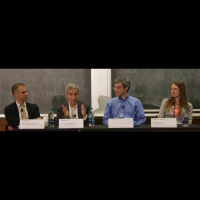
03/03/2016 Duração: 01h44minWhat separates a good teacher from a great one? How are digital technologies challenging traditional teaching methods? And are there distinctions between top-notch science instructors and their counterparts in humanities or social science? Former poet laureate Robert Pinsky, Weisskopf Professor of Physics Alan Guth and MIT biology professor Hazel Sive–all honored teachers–will explore these issues with Literature professor and Communications Forum director emeritus David Thorburn. David Thorburn is an MIT Literature professor, director emeritus of the Communications Forum, and a past winner of MIT’s MacVicar award for exemplary contributions to undergraduate teaching. Robert Pinsky is a three-term US Poet Laureate. He is a recipient of the William Carlos Williams Award from the Poetry Society of America and a Lifetime Achievement Award from the PEN American Center. Alan Guth is MIT’s Victor F. Weisskopf Professor of Physics, pioneer of the inflationary model of the universe and recipient of the MacVicar aw
-
![Vincent Brown: Designing Histories of Slavery for the Database Age]()
Vincent Brown: "Designing Histories of Slavery for the Database Age"
27/02/2016 Duração: 01h17minMultimedia scholarship invites reconsideration of how history has been, could be, and should be represented. By wrestling creatively and collectively with the difficult archival problems presented by social history of slavery, Harvard’s Vincent Brown hopes to chart new pathways for pondering history’s most painful and vexing subjects. This presentation considers three graphic histories of slavery — a web-based animation of Voyages: The Transatlantic Slave Trade Database, a cartographic narrative of the Jamaican slave revolt of 1760-61, and a web-based archive of enslaved family lineages in Jamaica and Virginia — that illustrate how the archive of slavery is more than the records bequeathed to us by the past; the archive also includes the tools we use to explore it, the vision that allows us to see its traces, and the design decisions that communicate our sense of history’s possibilities. Multi-media historian Vincent Brown is Charles Warren Professor of History, Professor of African and African-American Stud
-
![Caroline Jack: How Facts Survive In Public Service Media]()
Caroline Jack: "How Facts Survive In Public Service Media"
24/02/2016 Duração: 01h30minEconomic literacy has long been touted as a potential solution to national economic crisis and individual financial precarity. But what does it mean to be economically literate? In a field full of contestation, how do some perspectives get disqualified or excluded, and others held up as facts? Between 1976 and 1978, the nonprofit, quasi-governmental public service advertising organization The Advertising Council saturated the American media environment with messages about American citizens’ responsibility to become economically knowledgeable, and distributed over ten million copies of a glossy brochure designed to teach citizens the least they needed to know about the American economic system. Activist groups criticized the Ad Council campaign as propagandistic–but when these groups responded with their own information campaigns, they found themselves excluded from access to public funds and airwaves. Where was the line between objective information and propaganda? Who had the power to decide? How has this dy
-
![Is There a Future for In-Depth Science Journalism?]()
Is There a Future for In-Depth Science Journalism?
19/02/2016 Duração: 01h41minTraditional media outlets have been facing budget cuts and layoffs for years, with specialized reporters often among the first to go. And yet last year, Boston Globe Media Partners made a significant investment in launching STAT, a new publication that focuses on health, medicine and scientific discovery. STAT's leadership and reporting team will discuss the publication’s progress and how the field of science journalism is changing. Speakers Rick Berke is the executive editor of STAT and former executive editor of POLITICO. Berke joined The New York Times in 1986 and served as a political correspondent and senior editor for nearly three decades. Carl Zimmer is a national correspondent for STAT and hosts the site's “Science Happens" video series. Zimmer also writes the "Matter" column at The New York Times and has written 12 books including Soul Made Flesh, which was named as a New York Times Notable Book of the Year. Rebecca Robbins is a reporter for STAT covering money in life sciences. Moderator: Seth
-
![Amanda Lotz: Television Didnt Die -- But Broadband Distribution Revolutionized It]()
Amanda Lotz: "Television Didn't Die -- But Broadband Distribution Revolutionized It"
09/02/2016 Duração: 01h19minBeginning in the late 1990s, the technology and even mainstream press opined extensively on the coming death of television. A decade later—and a time that found television still very much alive—that theme evolved to instead pronounce the coming death of cable. Rather than demise, the emergence of broadband-distributed television has both reinvented the medium and revealed how extensively our expectations and understandings of television are based not on the medium of television but on logics developed for its broadcast distribution. Amanda D. Lotz’s talk presents key arguments of her current book project, Being Wired: How Cable Transformed Television and the Internet Revolutionized It All with a focus on what transpired when the long anticipated face off between “new media” and television finally took place in 2010. Lotz is professor in the Departments of Communication Studies and Screen Arts and Cultures at the University of Michigan where she studies contemporary media industries, television, and gender and
-
![John Jennings: The Cipher Back To Here]()
John Jennings: "The Cipher Back To Here"
04/02/2016 Duração: 01h17minJohn Jennings is an Associate Professor of Art and Visual Studies at the University at Buffalo-State University of New York. He is the co-author of the graphic novel The Hole: Consumer Culture, Vol. 1 and the art collection Black Comix: African American Independent Comics Art and Culture (both with Damian Duffy). Jennings is also the co-editor of The Blacker the Ink: Constructions of Black Identity in Comics and Sequential Art and co-founder/organizer of The Schomburg Center’s Black Comic Book Festival in Harlem, MLK NorCal’s Black Comix Arts Festival in San Francisco, and the AstroBlackness colloquium in Los Angeles at Loyola Marymount University. Jennings’ current comics projects include the Hiphop adventure comic Kid Code: Channel Zero, the supernatural crime noir story Blue Hand Mojo, and the upcoming graphic novel adaptation of Octavia Butler’s classic dark fantasy novel Kindred.
-
![Vivek Bald: Documenting South Asian Americas Interracial Past]()
Vivek Bald: "Documenting South Asian America's Interracial Past"
24/01/2016 Duração: 56minVivek Bald, an Associate Professor in CMS/W and member of the MIT Open Documentary Lab, discusses his transmedia project documenting the lives of Bengali Muslim ship workers and silk peddlers who entered the United States at the height of the Asian Exclusion Era, between the 1890s and 1940s, and quietly settled and intermarried within African American and Puerto Rican neighborhoods from Harlem to Tremé in New Orleans and Black Bottom, Detroit. The project consists of a book, Bengali Harlem and the Lost Histories of South Asian America (2013), a linear documentary film, In Search of Bengali Harlem (currently in production), and a community-sourced, web-based documentary and oral history project, “The Lost Histories Project” (in development). Bald’s talk and demo presented a new iteration of the online project and newly edited material from the documentary.
-
![CMS alumni panel: On the virtues of preparing students for jobs that dont yet exist]()
CMS alumni panel: On the virtues of preparing students for jobs that don't yet exist
12/01/2016 Duração: 15min"Each spring, the CMS side of CMSW catapults ten more master’s program graduates into the world. And each fall, we invite a bunch back to talk with prospectives. Of the five grads we feature in this podcast, four stayed close. In fact two helped start research groups in our department. And another two skipped to other parts of campus. One joined a Ph.D. program a few buildings down, and another kicked off the Media Lab’s new digital currency initiative. Margaret Weigel, '02 and one of our earliest graduates, works in digital education. 2007’s Dan Roy, the only panelist you didn’t hear, develops games for learning. Ilya Vedrashko, ‘06, works in data-driven consumer research. Erik Stayton, 2015, is a Ph.D. candidate in MIT’s program in History, Anthropology, Science, Technology and Society. And Chelsea Barabas, also 2015, is the newly minted advisor to the MIT Media Lab’s Digital Currency Initiative."
-
![Comparative Media Studies graduate alumni panel, Fall 2015]()
Comparative Media Studies graduate alumni panel, Fall 2015
21/11/2015 Duração: 01h13minOn the heels of the day’s graduate program information session, we hosted five alums of our master's degree program in Comparative Media Studies. They discussed their lives from MIT to their careers today. Here's who we featured: Margaret Weigel, ’02, who works in digital education: https://www.linkedin.com/profile/view?id=3427777 Dan Roy, ’07, widely known for his games for learning projects: https://www.linkedin.com/profile/view?id=2512953 Ilya Vedrashko, ’06, who does big data-driven consumer research: https://www.linkedin.com/profile/view?id=3838774 Erik Stayton, ’15, now a Ph.D. student at MIT’s program in History, Anthropology, Science, Technology and Society: http://web.mit.edu/hasts/graduate/stayton.html Chelsea Barabas, ’15, the newly minted advisor to the Media Lab’s Digital Currency Initiative: https://www.linkedin.com/profile/view?id=75805502
-
![Graduate Program Information Session, Fall 2015]()
Graduate Program Information Session, Fall 2015
17/11/2015 Duração: 01h58minOur information sessions bring prospective master's students to campus to meet our faculty and students, who discuss the program, its research, what it's like to apply, and the experience of studying at MIT for two years. The 2015 infosession was led by graduate program director Prof. Heather Hendershot and program administrator Shannon Larkin, and it featured research group directors like Ethan Zuckerman of the Center for Civic Media and Sarah Wolozin of the Open Documentary Lab; several current graduate students; and questions from attendees on-campus and online. If there was anything we didn't cover, don't hesitate to contact us at cmsw@mit.edu!
-
![Women in Politics - Representation and Reality]()
Women in Politics - Representation and Reality
11/11/2015 Duração: 01h47minWomen are chronically underrepresented in U.S. politics. Yet TV shows, fictions, and films have leapt ahead of the electoral curve to give us our first female president(s). What messages about women and power do these fictional representations of female politicians send? What connections (if any) can we draw between representation and reality? What challenges do real-life women politicians face as they represent themselves to voters and to the press? Mary Anne Marsh is a Boston-based political consultant who has worked on many local and national campaigns. She also serves as a Democratic political analyst on the FOX News Channel and on other national and local media. Ellen Emerson White is the author of many books for children and teens, including the critically acclaimed President’s Daughter series, which chronicles the experiences of a Massachusetts girl whose mother becomes the first female president of the United States. Moderator: Marah Gubar, Associate Professor of Literature at MIT, is the author of
-
![Tom Levenson: Einstein, Mercury, And The Hunt For Vulcan]()
Tom Levenson: "Einstein, Mercury, And The Hunt For Vulcan"
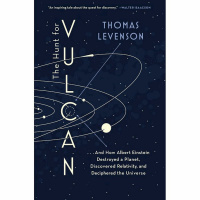
05/11/2015 Duração: 01h23minMIT professor of science writing Tom Levenson discusses his new book, The Hunt for Vulcan…And How Albert Einstein Destroyed a Planet, Discovered Relativity, and Deciphered the Universe. For decades, scientists discovered, dismissed, and rediscovered a hidden planet — Vulcan — thought to be responsible for the wobble in Mercury’s orbit. But in war-torn Berlin, in 1915, Albert Einstein proposed that gravity wasn’t as Newton saw it but was space itself, warped: what became his general theory of relativity. The discovery actually takes us back to 19th century astronomer Urbain Jean-Joseph Le Verrier, who originally identified Mercury’s wobble, and causes Levenson to ask: why did it take more than 50 years for science to change its mind about the existence of Vulcan? Levenson is director of our Graduate Program in Science Writing. He is the winner of Walter P. Kistler Science Documentary Film Award, Peabody Award (shared), New York Chapter Emmy, and the AAAS/Westinghouse award. His articles and reviews have appea
-
![Stuart Brotman: Global Internet Development Viewed Through The Net Vitality Lens]()
Stuart Brotman: "Global Internet Development Viewed Through The Net Vitality Lens"
03/11/2015 Duração: 01h17minNet Vitality is a new analytic approach to examine ways to sustain long-term Internet vibrancy, both in the United States and around the world, and helps inform future government policies that impact the deployment and adoption of broadband technologies. Unlike other comparative studies that rank countries quantitatively based on a simplistic assessment of broadband speeds, Stuart N. Brotman’s Net Vitality Index, released earlier this year, also measures countries qualitatively to determine how well they are performing in a global competitive environment, gauging the true vitality of a country’s Internet ecosystem. Based on five years of research, the Net Vitality Index is the first holistic analysis of the global broadband Internet ecosystem, identifying the United States, South Korea, Japan, the United Kingdom, and France as the top-tier leaders. Unlike the one-dimensional rankings that serve as the basis of most broadband comparative studies, Brotman’s composite metric takes into account 52 factors develo
-
![Heather Hendershot From Firing Line To The OReilly Factor]()
Heather Hendershot; "From Firing Line To The O'Reilly Factor"
23/10/2015 Duração: 01h23minWilliam F. Buckley’s public affairs program Firing Line (PBS, 1966–1999) offered a space for no-holds-barred, honest intellectual combat at its finest. The conservative Buckley hoped to convert viewers, but there was more to it than that. You could actually learn about other points of view, and thereby become a better liberal or a better conservative from watching the show. There is simply no equivalent on TV today. Conservatives have Fox News, liberals have MSNBC, and in more neutral territory we find C-SPAN. Overall, politically oriented broadcasting has become a vast echo chamber (especially on talk radio), with many tuning in largely to have their views confirmed—and to hear the other side vilified. What happened? How did we get from Firing Line to The O’Reilly Factor? And how can we possibly fix things? Hendershot’s talk will provide the historical, regulatory, and political context we need in order to begin to address these very difficult questions. Heather Hendershot is a professor of film and media i
-
![Sarah Zaidan, The Adventures Of Ms. Meta: Celebrating The Female Superhero Through Digital Gaming]()
Sarah Zaidan, "The Adventures Of Ms. Meta: Celebrating The Female Superhero Through Digital Gaming"
18/10/2015 Duração: 01h04minThe importance of female superheroes in Western culture cannot be ignored. From Wonder Woman in the 1940s to Captain Marvel in the 2010s, the inspiration and cultural impact these representations of heroism provide fans regardless of gender are undeniable. While there is a wealth of research examining the representation of the female superhero and how this speaks to perceptions of femininity across the past eighty years, its focus is often the prevalence of stereotypical over authentic depictions, and the harmful effects of this on society. Sarah Zaidan‘s research combines the platforms of video games with the artistic styles and narrative themes of comics and historical fact, culminating in an original game that celebrates the power of the female superhero, and her cultural importance. The game tells the story of Ms. Meta, a contemporary superhero created by the player. As she journeys through time to stop her nemesis’ plans, she will encounter characters drawn from the stories of women and fans from each e
-
![From The Neolithic Era To The Apocalypse: How To Prepare For The Future By Studying The Past]()
From The Neolithic Era To The Apocalypse: How To Prepare For The Future By Studying The Past
08/10/2015 Duração: 01h48minFor thousands of years, humans have experienced cycles of empire building and retreat, from the neolithic settlers of Levant and the Indus Valley to the ancient Cahokia and Maya civilizations. What can new discoveries teach us about how to plan our next thousand years as a global civilization? Authors Charles C. Mann and Annalee Newitz talk about how ancient civilizations shed light on current problems with urbanization, food security, and environmental change. Charles C. Mann is the author, most recently, of 1493, a New York Times best-seller, and 1491, winner of the National Academies of Science’s Keck award for best book of the year. His next project, The Wizard and the Prophet, is a book about the future that makes no predictions. An early version of the introductory chapter was a finalist for a National Magazine Award. Annalee Newitz writes science nonfiction and science fiction. She’s editor-in-chief of Gizmodo.com and founding editor of io9.com. She’s the author of Scatter, Adapt, and Remember: How H
-
![Jim Crow and the Legacy of Segregation Outside of the South]()
Jim Crow and the Legacy of Segregation Outside of the South
07/10/2015 Duração: 01h41minPolice shootings and the Black Lives Matter campaign have shone a spotlight on how different the everyday experiences are of white Americans and Americans of color. While much attention has been paid to these seemingly daily occurrences, the historical forces that led to our current situation have been less discussed: Is the de facto segregation that exists in many Northern cities a result of the lack of forced integration of the type that took place in the South? And is the mass incarceration of and police brutality inflicted on black Americans a result of these same forces? Melissa Nobles is the Kenan Sahin Dean of the School of Humanities, Arts, and Social Sciences and Professor of Political Science at MIT. She is also a collaborator and advisory board member of Northeastern Law School’s Civil Rights and Restorative Justice clinic. Her current research is focused on constructing a database of racial murders in the American South between 1930 and 1954. She is the author of two books: Shades of Citizenship
-
![Hiromu Nagahara: Hierarchy And Democracy In Modern Japans Mass Media Revolution]()
Hiromu Nagahara: "Hierarchy And Democracy In Modern Japan's Mass Media Revolution"
30/09/2015 Duração: 01h26minModern Japan experienced what could be described as its first wave of “mass media revolution” in the period stretching from the mid-1920s into the 1930s, when new forms of media industry as well as technology vastly expanded the number of potential consumers of media products. This talk, with Hiromu Nagahara, explores the political implications of this development, especially as it relates to how the rise of mass media reshaped existing social and cultural hierarchies in Japan (and how, in some cases, it didn’t). Based on his current book project, Japan’s Pop Era: Music in the Making of Middle-Class Society, this talk will focus on the life and career of Horiuchi Keizō (M.S. 1923), an MIT grad who found himself in the center of all of this as a prominent composer, critic, radio broadcaster, and publisher.
-
![Jane McGonigal discusses SuperBetter with MITs Scot Osterweil]()
Jane McGonigal discusses "SuperBetter" with MIT's Scot Osterweil
15/09/2015 Duração: 01h07minJane McGonigal is the internationally acclaimed game designer and author, most recently of "SuperBetter: A Revolutionary Approach to Getting Stronger, Happier, Braver and More Resilient–Powered by the Science of Games". In a wide-ranging conversation, she spoke at MIT with Scot Osterweil, creative director of the MIT Education Arcade (education.mit.edu). The event was hosted by Harvard Book Store.
-
![Danielle Keats Citron and Brianna Wu: Hate Crimes In Cyberspace]()
Danielle Keats Citron and Brianna Wu: "Hate Crimes In Cyberspace"
05/05/2015 Duração: 01h25minDanielle Keats Citron is Lois K. Macht Research Professor of Law at the University of Maryland Francis King Carey School of Law. Brianna Wu is Head of Development at Giant Spacekat and a well-known public speaker on issues affecting women in tech. Most Internet users are familiar with trolling—aggressive, foul-mouthed posts designed to elicit angry responses in a site’s comments. Less familiar but far more serious is the way some use networked technologies to target real people, subjecting them, by name and address, to vicious, often terrifying, online abuse. In an in-depth investigation of a problem that is too often trivialized by lawmakers and the media, Danielle Keats Citron exposes the startling extent of personal cyber-attacks and proposes practical, lawful ways to prevent and punish online harassment. A refutation of those who claim that these attacks are legal, or at least impossible to stop, Hate Crimes in Cyberspace reveals the serious emotional, professional, and financial harms incurred by victi