Needs No Introduction
- Autor: Vários
- Narrador: Vários
- Editora: Podcast
- Duração: 266:48:31
- Mais informações
Informações:


Sinopse
A series of speeches and lectures from the finest minds of our time. Fresh ideas from speakers of note.
Episódios
-
![Labour Fair 2026: The radical labour of care]()
Labour Fair 2026: The radical labour of care
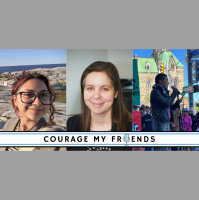
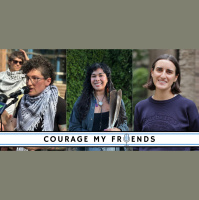
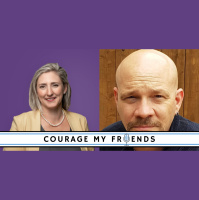
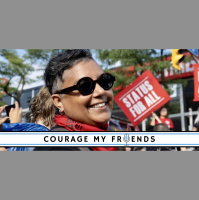
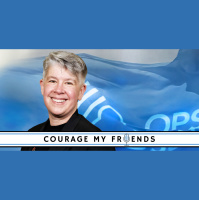
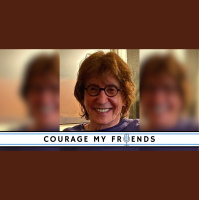
02/04/2026 Duração: 01h09minThis latest episode of the Courage My Friends podcast series features "The Radical Labour of Care" panel discussion with: Indigenous midwife, leader, and educator, Claire Dion Fletcher; crisis outreach worker, case manager, and advocate in Toronto's Downtown East, Lorraine Lam; and program director of the Latinx Womyn's Program at the Toronto Rape Crisis Centre/Multicultural Women Against Rape, Grissel Orellana. It is moderated by Eliza Chandler, associate professor in the School of Disability Studies and executive director of the Office of Social Innovation at Toronto Metropolitan University. This latest session of TMU's Transformation Café series was hosted at the 34th annual Labour Fair at George Brown Polytechnic. Under this year's Labour Fair theme, "Building a Working Peoples' City," the panel discussed the essential, but undervalued labour of care, interventions in the increasingly inaccessible, unaffordable and hostile city and building practices of mutual aid, community safety and collective surviva
-
![Mining, militarism and organizing against the march to war]()
Mining, militarism and organizing against the march to war
18/03/2026 Duração: 01h05minIn the latest episode of the Courage My Friends series, we welcome organizer with the Mining Injustice Solidarity Network Kara Anderson and welcome back Canada organizer for World Beyond War and coordinator of the Arms Embargo Now Campaign, Rachel Small. We discuss Canada's radical turn toward militarism and its ramping up of defence spending, the many and deep connections between militarism and mining in the mining capital of the world and solidarity organizing against the march to war. Reflecting on Canada's increased defence spending, Small says: " Canadian military spending had already doubled from $20 billion to over $40 billion over the past decade … And then last June, Carney gave it an extra $9 billion overnight and then committed to doubling it again over the next decade. So … the number that's kind of being floated around is that the new defence spending would amount to $150 billion per year in the next decade … It's vastly more than the federal government spends on all health and social transfers
-
![Pension divestment: From funding crises to a radical pension politics]()
Pension divestment: From funding crises to a radical pension politics
18/02/2026 Duração: 01h03minIn our third episode of the season, Tom Fraser, a union researcher and author of Invested in Crisis: Public Sector Pensions Against the Future, and Becca Steckle, a research and policy analyst with Just Peace Advocates, join us to discuss how Canada's public sector pensions are funding crises from housing to genocide, the restructuring of Canadian retirement security into capital funding for militarism and welfare erosion around the world and the urgent need for divestment toward a radical pension politics. According to Fraser: "What I see as specifically contradictory about the structure of the pension fund is that in an age of de-industrial capitalism returns on investment and ..profits ..are directly contradictory with the point of the pension itself … [which] is to enable the continued life of the worker after retirement. But the structure of that sort of capital accumulation necessitates taking value from those same sorts of necessities. There is a basic level contradiction in terms between the pension a
-
![Oxfam Inequality Report 2026: Resisting the rule of the rich and protecting freedom from billionaire power]()
Oxfam Inequality Report 2026: Resisting the rule of the rich and protecting freedom from billionaire power
28/01/2026 Duração: 01h08minIn our second episode of the season, executive director of Oxfam Canada, Lauren Ravon returns for our annual focus on the Oxfam Inequality Report and this year we are also joined by senior director of Strategy and Innovation at Family Service Toronto and national director of Campaign 2000, Leila Sarangi. We discuss Oxfam's latest report on global inequality, Resisting the Rule of the Rich: Protecting Freedom from Billionaire Power, the capture of political power by the billionaire class, the rise of authoritarianism and how this is being lived in Canada. Ravon says: "One of the main points that we're trying to get across in this year's Oxfam report. Is saying that not only does massive wealth allow you to buy luxury items … It allows you to buy political influence, and this is really what we see as most troubling … this political capture … around the world and it's a risk for us here in Canada too, is that ultimately extreme wealth concentration, this kind of billionaire wealth that we're talking about, is
-
![Venezuela, Canada and the Donroe Doctrine]()
Venezuela, Canada and the "Donroe Doctrine"
15/01/2026 Duração: 01h07minIn the season 10 premiere of the Courage My Friends podcast series, we are pleased to welcome back journalist, author and director of the Tricontinental Institute for Social Research, Vijay Prashad and professor of International Relations at St. Thomas University, Shaun Narine. We discuss the recent US military attack on Venezuela and the abduction of President Nicolas Maduro and First Lady Cilia Flores, the Trump administration's new National Security Strategy (the so-called "Donroe Doctrine") and what this means for Canada, and how all of this is connected to the decline of US hegemony, the rise of Asia and the West's shift into hyper-imperialism. Speaking on the US National Security Strategy or the "Donroe Doctrine", Narine says: "They're actually saying, look, the Western Hemisphere is ours … And I think in a lot of ways, the Venezuela situation was an easy sort of first pass at asserting this …'Let's go in. Let's take out Maduro. And let's send the message to the entire region"... And of course, the mes
-
![December 10th Human Rights Day panel discussion: The ongoing struggle for rights in Canada]()
December 10th Human Rights Day panel discussion: The ongoing struggle for rights in Canada
18/12/2025 Duração: 01h34minOur final episode of this Courage My Friends season features a December 10th Human Rights Day Panel Discussion, the first of a series of events celebrating the 50th anniversary of the Community Worker Program at Toronto's George Brown College. Community workers and human rights advocates, Brianna Olson Pitawanakwat, Samira Mohyeddin, Diana Gallego, Desmond Cole and Diana Chan McNally discuss the meaning of human rights in Canada 77 years after the UN adoption of the Universal Declaration of Human Rights, critical issues facing us today and the power of solidarity-driven, rights-based organizing. Speaking to Canada's approach to human rights, Pitawanakwat says: "A big wakeup call was a couple of days ago when the UN passed the International Day Against Colonialism and Canada abstained. Because Canada is very much still rooted in this colonial mechanism and ideology here … In Anishinaabe culture, we don't rely on the idea of rights, rights are a European construct. We rely on the idea of responsibility … If we
-
![The AI hype-machine: Canadas ill-advised national sprint on artificial intelligence]()
The AI hype-machine: Canada's ill-advised 'national sprint' on artificial intelligence
27/11/2025 Duração: 01h32minIn episode six of the Courage My Friends' season nine, we welcome impact strategist with Animikii, Indigenous Technology, Jeff Doctor, technology and human rights lawyer with Tekhnos Law and senior fellow with The Citizen Lab, Cynthia Khoo, senior researcher with the Canadian Centre for Policy Alternatives, Hadrian Mertins-Kirkwood. We discuss Canada's accelerated approach to artificial intelligence and the mobilization of civil society groups against it, multiple impacts of largely unregulated AI on people, planet and democracy, Indigenous perspectives on data sovereignty and digital colonialism and the meaning of AI beyond the hype. Reflecting on the government's accelerated AI development, Mertins-Kirkwood says: "There's definitely a distinct moment that's happening right now. A particular hype cycle, a push to adopt this current iteration of 'artificial intelligence', whatever that means … The question is why are we doing it. The way that the federal government in particular talks about AI is frankly ver
-
![You Will Not Kill Our Imagination: Author Saeed Teebi on Palestine, writing and imagination]()
You Will Not Kill Our Imagination: Author Saeed Teebi on Palestine, writing and imagination
05/11/2025 Duração: 01h22sIn episode five, we are pleased to welcome award-winning author Saeed Teebi who speaks to us about his powerful new book, You Will Not Kill Our Imagination: A Memoir of Palestine and Writing in Dark Times. In our annual focus on the power of storytelling, we discuss what it means to be a Palestinian writer in these times, the challenges of writing against dehumanizing narratives, complicity in the attempted erasure of Palestinian life, identity and art through both violence and silence and how imagination, story and writing become profound acts of resistance in a time of genocide. On the condemnation of Palestinian language and writing, Teebi says: "In the face of actual violence waged against them, Palestinians are tried and convicted of presumptive violence for their language.Our words are assumed to be code words or dog whistles that mean something else necessarily more nefarious than what we say they mean … The usual language remains available to the rest of the world to use freely. It is only Palestinia
-
![Bills C-2 and C-12: How Canada’s border security acts endanger refugee rights]()
Bills C-2 and C-12: How Canada’s border security acts endanger refugee rights
15/10/2025 Duração: 01h06minIn episode four, we welcome co-executive director of the Migrant Workers Alliance for Change, Karen Cocq, advocacy and media relations coordinator at The Refugee Centre in Montreal, Alina Murad and President of the Canadian Association of Refugee Lawyers, Aisling Bondy. We discuss the Carney Government’s new border security acts, Bill C-2 and its questionable make-over with the recently tabled Bill C-12, how they effectively rewrite Canada’s approach to refugee rights and protections, whether this new security regime is a response to the Trump tariff demands or an opportunity to continue Canada’s years-long tightening of the borders, and if passed, what these acts could mean for those seeking asylum and for Canada as a whole. On Bill C-2, Cocq says: “We're calling it this mass deportation machine … government being able to use these new powers to remove many more people, that's what's really frightening to us … that it's going to look a little bit more like what's happening in the United States.” On the tabli
-
![Crisis or scandal? The deliberate dismantling of Ontarios public college system]()
Crisis or scandal? The deliberate dismantling of Ontario's public college system
01/10/2025 Duração: 01h08minIn our third episode we welcome support staff president for the Ontario Public Service Employees Union Local 418 at St.Lawrence College. Amanda Shaw, second vice president of OPSEU Local 415 at Algonquin College, Martin Lee and from George Brown College, member of OPSEU's part-time and sessional divisional executive, Ben McCarthy. We discuss the mass layoffs and program and campus closures across Ontario's 24 publicly funded colleges, impacts on college workers, students, and wider communities, what this means for the future of public post-secondary education and how what has been publicized as a "crisis" is really a scandal of the deliberate dismantling of the public college system by the Government of Ontario. According to Lee: “We've been using the word 'crisis' a lot, right? And, you know, it's got all the symptoms of being a crisis ... But it's not a crisis, it's a scandal. What we're actually looking at is a scandal. A crisis is something that happens. A rainfall, you know, it's an act of God. No, no, t
-
![On September 20: Draw the line for people, for peace, for planet]()
On September 20: Draw the line for people, for peace, for planet
15/09/2025 Duração: 56minIn this episode we welcome, climate justice and Indigenous rights organizer from Stellat’en First Nation and senior advisor at the David Suzuki Foundation, Janelle Lapointe; member services and movement building manager with Climate Action Network Canada, Lauren Latour and Canada organizer for World Beyond War, Rachel Small. We discuss the Draw the Line National Day of Action taking place across Canada on September 20, the reasons for this historic cross-movement coalition and the urgency of drawing the line now in this moment of converging and overwhelming crises, for people, for peace and for the planet. Speaking to origins of Draw the Line, Latour says: “After years and years and years of communities from across progressive spaces saying, we need to learn how to work together in community. We need to learn how to build coalition. It just felt like this was the perfect opportunity for that.” On the critical need for a coalition, Lapointe says: “We're all waking up to the root cause of the crises, which is i
-
![Lawless: The complete decriminalization of abortion… only in Canada]()
Lawless: The complete decriminalization of abortion… only in Canada
03/09/2025 Duração: 01h01minIn our season nine premiere, we welcome Martha Paynter, nurse, scholar and author of Lawless: Abortion Under Complete Decriminalization. We discuss Canada’s complete decriminalization of abortion (the only country to do so), the fascinating and often fraught history that brought us to this point, abortion as a public good, the influence of the anti-choice lobby here and the overturning of Roe vs. Wade in the US, and what it takes to make abortion truly equitable when decriminalization is not enough. Reflecting on the need to understand abortion as a public good, Paynter says: “We have these major cultural forces that just reiterate this idea that abortion is rare and hard. And it's not, it's very normal. It's very common and it takes seven minutes. And actually it will allow you to follow your dreams. Whether that dream is to escape a violent relationship or to finish your graduate degree or whatever. So we do need to have this shift in the way we talk about abortion. And we need to understand abortion, not
-
![Palestine and the weaponizing of hunger and the climate crisis]()
Palestine and the weaponizing of hunger and the climate crisis
14/05/2025 Duração: 01h02minIn episode nine of the Courage My Friends series, we welcome visiting professor and dean of the faculty of agriculture and veterinary medicine at Gaza’s Al-Azhar University, Dr. Ahmed Abu Shaban. We discuss the weaponization of already fragile food systems in Gaza, the acceleration of the climate crisis through conflict and Palestinian resilience under occupation. Reflecting on the nexus of food, climate and occupation, Abu Shaban shares: “My father passed away in 2021 and we had a farm in Gaza. This farm was destroyed several times. And this farm is an olive trees farm. And olives, you know, you need to wait at least three to five years to get production out of it.So several times we cultivate the seedlings … The Israelis come inside … and destroy the land, cut the trees. My father would just … recultivate the trees again. I told him, Listen, but this is really too expensive because we are investing a lot of money in this and we never see the production of them. And my father said, Let them cut it for 100
-
![Labour Fair 2025: Labour now: Union responses to the polycrisis]()
Labour Fair 2025: Labour now: Union responses to the polycrisis
16/04/2025 Duração: 54minIn episode eight, we return to the George Brown College Labour Fair and a discussion with Ontario Federation of Labour president Laura Walton and chief steward and second vice president of OPSEU/SEFPO Local 556 Jeff Brown. We discuss the multiple issues facing the labour movement, union priorities and, in this age of polycrisis, what exactly we are working for. Speaking to the upcoming federal elections, Walton says: “I think we all can agree it's not going to be an NDP federal government. It's either gonna be Liberals or Conservatives. And I call them cancer and chemo; one's gonna kill you, the other one's gonna make you sick. We're going to be under, in Ontario, two governments that are not worker friendly, both federally and provincially. And it's going to be incumbent on workers to really embrace organizing principles … Now's not the time to be quiet. Now's the time that we're going to have to join our voices together to really push back." Reflecting on the how the trade war may impact already underfunded
-
![Labour Fair 2025: Building a workers first emergency response to the tariff crisis]()
Labour Fair 2025: Building a workers' first emergency response to the tariff crisis
11/04/2025 Duração: 01h07minIn episode seven, we are pleased to feature executive director of the Workers’ Action Centre, Deena Ladd. In her keynote address for the 33rd annual Labour Fair at Toronto’s George Brown College, No One Left Behind: Building a Workers’ First Emergency Response to the Tariff Crisis that Unites Us, Ladd discusses the current trade war, the dangers facing workers and a solidarity-driven plan that puts workers first. Reflecting on what’s needed in a workers’ first approach to the tariff crisis, Ladd says: “Our communities are already in trouble. And we know that the tariffs imposed are gonna have a ripple impact, far worse than the pandemic's… We desperately need a government strategy that has learned from these past economic crises to ensure that no one gets left behind. ..To make sure that when you are providing supports, that they first of all have to be adequate. That they're not institutionalizing poverty. That they're accessible … And that they're structured in a way that doesn't unintentionally punish peop
-
![Labour Fair 2025: The critical need for labour education]()
Labour Fair 2025: The critical need for labour education
02/04/2025 Duração: 54minIn episode six, we feature the opening discussion of the 33rd annual Labour Fair at Toronto’s George Brown College. Under this year's theme, What Are We Working For? JP Hornick, president of OPSEU/SEFPO, (Ontario Public Service Employees Union), speaks on the critical need for labour education, labour organizing amid the changing nature of work and the crisis facing Ontario colleges. Reflecting on the need for labour education Hornick says: “These are the spaces where we learn how to organize, where we learn how to build community – it provides the critical analysis that people need to understand why there are inequities in society. Why systems of oppression such as racism, ableism, sexism, ageism, homophobia and transphobia are being used right now in this moment to try and divide workers from one another. Programs like the School of Labour or labour education are where we actually start to have conversations with workers about why we're not one another's enemies. I think about this quote from Angela Davis:
-
![Rebranded fascism, higher education and the burden of conscience]()
Rebranded fascism, higher education and the burden of conscience
12/03/2025 Duração: 59minIn episode five, we are pleased to welcome back Henry Giroux, scholar, cultural critic and author, most recently of The Burden of Conscience: Educating Beyond the Veil of Silence. We discuss the rise of authoritarianism in the US and around the world as an updated fascism, its attack on democracy and higher education and the urgent need for solidarity, critical pedagogy and resistance in the face of the unspeakable. Reflecting on the necessity of higher and critical education in these times, Giroux says: “Education is the glue. Education is the bridge that stands between fascism and hope, between fascism and justice, between fascism and a socialist democracy, a real democracy, a radical democracy. And if we don't grasp the centrality of education here in terms of both its power and its role, both in and outside of schooling, we're in trouble. It's not going to work.” About today’s guest: Henry A. Giroux currently holds the McMaster University Chair for Scholarship in the Public Interest in the English and C
-
![George Brown College’s 25th annual Mental Health Conference: Decolonizing learning and creating conditions for student well-being]()
George Brown College’s 25th annual Mental Health Conference: Decolonizing learning and creating conditions for student well-being
19/02/2025 Duração: 39minIn episode 4, we focus on the upcoming 25th annual Mental Health Conference at George Brown College in Toronto and this year’s theme, Thriving Together in the Classroom: Creating the Conditions for Student Well-Being. Author, storyteller, Indigenous academic and conference keynote speaker Carolyn Roberts; dean of the Centre for Preparatory and Liberal Studies, Susan Toews; and director of Student Well-Being and Support, Alex Irwin discuss this year’s conference and its focus on teaching, the mental health and well-being of post-secondary students, decolonizing learning and Indigenous resurgence through education. Reflecting on the need for decolonizing and re-storying education, Roberts says: “When Indigenous students step into the classroom, we are being asked to leave a part of who we are at the door, because that's not talked about or shared within those spaces. So we have to leave our indigeneity at the door to come in to learn about something else. And that's not a sustainable thing.And not only for Ind
-
![Oxfam Inequality Report 2025: Billionaire colonialism in Canada]()
Oxfam Inequality Report 2025: Billionaire colonialism in Canada
13/02/2025 Duração: 40minIn part two of our focus on Oxfam’s latest report: Takers Not Makers: The Unjust Poverty and Unearned Wealth of Colonialism, we welcome associate professor and faculty chair of the Indigenous Relations Initiative at McGill University, Dr. Veldon Coburn. Reflecting on his 2022 book (co-edited with David Thomas) Capitalism and Dispossession: Corporate Canada at Home and Abroad, we speak of the growth of billionaire colonialism and corporate power in Canada and the ways in which this is anchored in Canada’s continuing history of settler colonialism. Reflecting on corporate extraction and dispossession of Indigenous resources, Coburn says: “It's easier to steal and to take what's existing there, exactly what the Oxfam Report is titled, Takers Not Makers is the failure of the promise of capital to reproduce itself. .. wealth is only created through ongoing theft and dispossession… taking from someone else. And the broligarchs, the billionaire oligarchy, have seized quite a few of the interests of the State. And i
-
![Oxfam Inequality Report 2025: The takers not makers of billionaire colonialism]()
Oxfam Inequality Report 2025: The takers not makers of billionaire colonialism
05/02/2025 Duração: 43minIn part one of this discussion, executive director of Oxfam Canada Lauren Ravon returns to discuss Oxfam’s latest report: Takers Not Makers: The Unjust Poverty and Unearned Wealth of Colonialism. Ravon and Resh Budhu explore the extreme wealth and power of the billionaire class, this era of “billionaire colonialism” and what it will take to decolonize economies in Canada and throughout the world. According to Ravon: “I would say the highlight of this year's report is really well captured by the title Takers Not Makers, because we're focusing not just on this extreme and I'd say obscene wealth accumulation, not just the amount of wealth that's being held by the very few, but the fact that this is not wealth that is earned in any sense. This is wealth that has been taken, whether through corruption, through cronyism, through monopolistic power, through connections through inheritance, but also through the legacy, the very life legacy of colonialism." About today’s guests: Lauren Ravon, executive director of